
焼 Meaning, Reading, and Vocabulary|Onyomi ショウ・Kunyomi や.く
The kanji 焼 is related to fire (火) and carries the meanings 'to bake,' 'to grill,' or 'to burn.'
Its onyomi is ショウ, and its kunyomi readings are や.く (to bake/grill) and や.ける (to be baked/burn).
It is an essential kanji frequently seen in daily life and the JLPT N2 exam, appearing in words like 焼肉 (yakiniku) and 燃焼 (combustion).
Kanji at a glance
Core meaning / core image
焼 is a kanji that represents the act of burning something with fire or grilling food. It is used in a wide variety of situations involving fire and heat, from cooking and chemical combustion to getting a sunburn.
Kanji structure breakdown
Mnemonic story
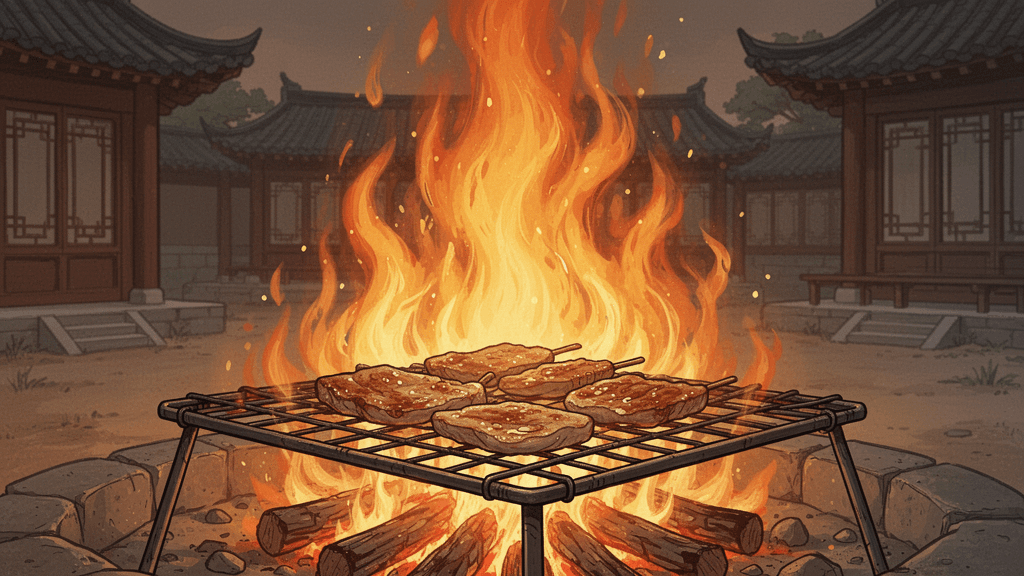
This kanji depicts blazing flames (火) rising high (尭) into the air. It evolved to mean cooking or grilling food over a strong fire, as well as burning.
On'yomi and kun'yomi
On reading
Kun reading
Commonly used words
Example sentences
Mini quiz
Which of the following pairs the kanji with its correct reading?
One-line summary
Derived from the image of fire (火) rising high, 焼 means 'to bake' or 'to burn' and is widely used in words related to cooking and combustion.
FAQ
What is the difference between 焼く (やく) and 焼ける (やける)?
焼く is a transitive verb meaning 'to bake' or 'to burn,' referring to the action of you directly baking or grilling something. On the other hand, 焼ける is an intransitive verb meaning 'to be baked' or 'to burn,' describing the state of an object being cooked or burned by fire.
When is the onyomi ショウ typically used?
It is mainly used in kanji compound nouns related to the chemical process of burning or fires, such as 燃焼 (ねんしょう, combustion) and 全焼 (ぜんしょう, burned down), which have a more formal or technical tone.
