
Search…

Search blog post titles and content.

Kanji & VocabularyN3

Learn the meaning, structure, readings (onyomi/kunyomi), and common vocabulary of the kanji 困 (troubled) with example sentences.

Published at Jun 26, 20264 min read

困 Meaning, Reading, and Vocabulary|Onyomi コン・Kunyomi こま.る

Key takeaways

The kanji 困 depicts a tree (木) trapped in a narrow space (囗), suffering because it cannot grow.

Its onyomi is 'コン' and its kunyomi is 'こま.る'.

It is frequently used to express difficult or troubling situations, such as in the words '困難' (difficulty) and '困惑' (bewilderment).

Kanji at a glance

N3

Meaning

To be troubledTo be distressedTo be in a difficult situation

On reading

コン

Kun reading

こま.る

Radical

囗 (Enclosure (surrounded shape))

Strokes

7 strokes

Core meaning / core image

Core Meaning

The kanji 困 means 'trouble', 'distress', or 'difficulty', depicting being trapped in a blocked space unable to move. It is mainly used to describe situations where you are at a loss because no solution is in sight.

Kanji structure breakdown

Structure breakdown

困 = 囗 + 木

Enclosure

Meaning hint

Represents a wall blocked on all sides or a narrow space.

Tree

Image element

Represents a plant, specifically a tree.

Imagine a tree surrounded by walls, trapped and unable to spread its branches.

Mnemonic story

Mnemonic story

A single tree (木) is trapped inside a solid wall (囗) blocked on all sides. Unable to get proper sunlight or space to spread its branches, its growth is stunted, leaving it in great distress. This image of a trapped tree gave rise to the meanings 'to be troubled' or 'to be in a difficult situation'.
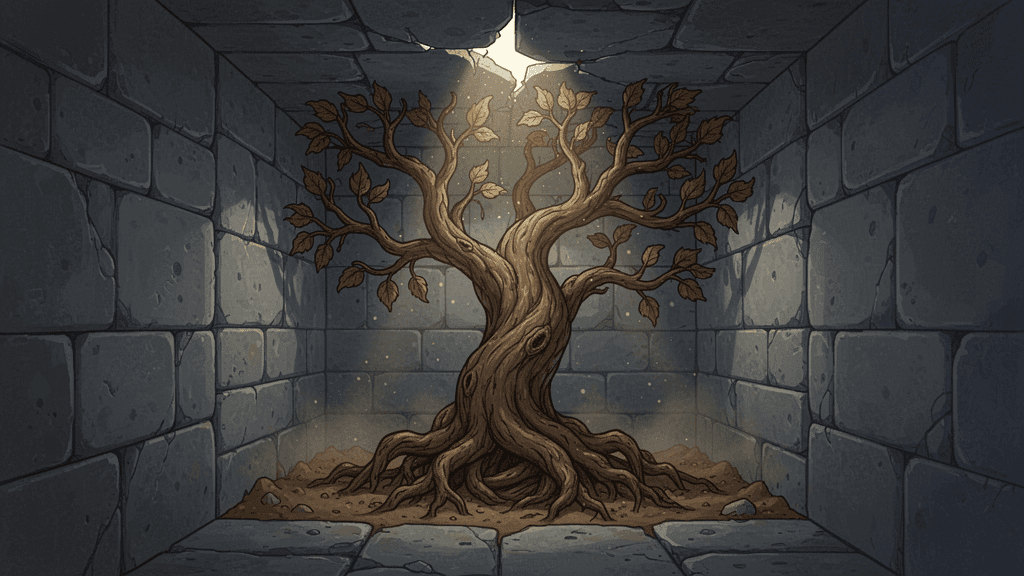
困 kanji story image

On'yomi and kun'yomi

On reading

コン
  • 困難こんなんN3

    Difficulty, hardship

  • 貧困ひんこんN1

    Poverty

  • 困惑こんわくN1

    Bewilderment, perplexity

The onyomi 'コン' is mainly used in kanji compound nouns like '困難' (difficulty) or '貧困' (poverty).

Kun reading

こま.る
  • 困るこまるN5

    To be troubled, to be at a loss

The kunyomi 'こまる' is a very frequently used verb in daily life when saying 'I am in trouble' or 'I don't know what to do'.

Commonly used words

  • 困る
    こまる

    To be troubled, to be at a loss

    This is the most basic verb expression.

  • 困難
    こんなん

    Difficulty, hardship

    Refers to a difficult state where things are not progressing smoothly.

  • 貧困
    ひんこん

    Poverty

    A state of living in distress due to a lack of property or resources.

  • 困惑
    こんわく

    Bewilderment, perplexity

    Expresses a feeling of bewilderment, not knowing how to cope.

Example sentences

Example 1

お金がなくて困っています

おかねがなくてこまっています。

Okane ga nakute komatte imasu.

Translation

I'm in trouble because I have no money.

Example 2

その問題は解決が困難だ。

そのもんだいはかいけつがこんなんだ。

Sono mondai wa kaiketsu ga konnan da.

Translation

That problem is difficult to solve.

Example 3

突然の質問に困惑した

とつぜんのしつもんにこんわくした。

Totsuzen no shitsumon ni konwaku shita.

Translation

I was bewildered by the sudden question.

Mini quiz

Which of the following words containing the kanji 困 has the incorrect reading?

One-line summary

In a nutshell

The kanji 困 originates from the image of a tree trapped in a narrow space, representing a state of being troubled, distressed, or at a loss for what to do.

FAQ

FAQ

What is the difference between 困る (こまる) and 難しい (むずかしい)?

難しい expresses the objective fact that a problem or situation itself is 'difficult' (high level of difficulty). On the other hand, 困る is used to express a subjective feeling or state of being 'troubled' or 'at a loss' because you don't know how to handle a certain situation.

Can 困る be used to mean 'tired'?

In Japanese, 困る (こまる) does not mean 'tired'. To say you are tired, use 疲れる (つかれる). However, note that in Chinese, 困 is often used to mean 'sleepy', so learners familiar with Chinese characters should be careful not to confuse them.

困 Meaning, Reading, and Vocabulary|Onyomi コン・Kunyomi こま.る | Daily Nihongo