
閉 Meaning, Reading, and Vocabulary Summary | Onyomi ヘイ・Kunyomi と.じる
The kanji 閉 (to close) means to close a door or end a certain state.
It has various readings, such as the onyomi ヘイ and the kunyomi とじる or しめる, so you need to distinguish them based on the context.
It is an essential kanji frequently seen in daily life and JLPT exams, appearing in words like 閉店 (store closing) and 閉める (to close).
Kanji at a glance
Core meaning / core image
閉 means 'to close' an open door or entrance. In addition to physically closing a door, it is also used in an extended sense to mean that a business or event 'ends (is concluded)'.
Kanji structure breakdown
Mnemonic story
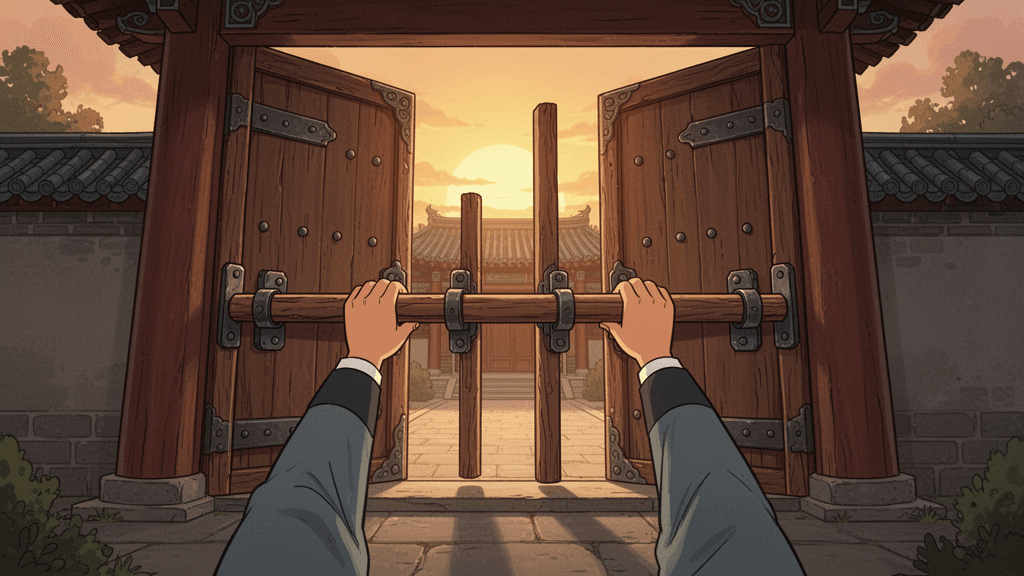
This character depicts a wooden latch (才) placed across a gate (門) to block the entrance. The image of securing a door so it won't open gave rise to the meaning 'to close'.
On'yomi and kun'yomi
On reading
Kun reading
Commonly used words
Example sentences
Mini quiz
Which of the following is the most natural Japanese expression for 'to close the door'?
One-line summary
閉 (to close) means to close a door or to end. Depending on the situation, it is read differently, such as しめる or とじる, so it is good to remember the nuance differences.
FAQ
How are 閉める (しめる) and 閉じる (とじる) different?
Generally, '閉める' is used when blocking an open physical space like a door, window, or drawer. On the other hand, '閉じる' is often used when bringing two parts together or ending a state, such as closing a book, closing one's eyes, or ending a meeting.
When do you use 閉まる (しまる)?
'閉まる' is an intransitive verb meaning 'to close' or 'to be closed'. It is naturally used when you don't close something yourself, but rather when a door closes from the wind, an automatic door closes, or a store is closed after business hours.
